
- What is the average salary in the U.S.?
- Why does it vary so much by state?
- How do experience and certification affect your salary?
- What else can increase salary?
- How to evaluate sterile processing technician salary?
- What is the future outlook for sterile processing technicians?
- FAQs
- References
Sterile Processing Technician Salary: What Should You Expect in 2026?
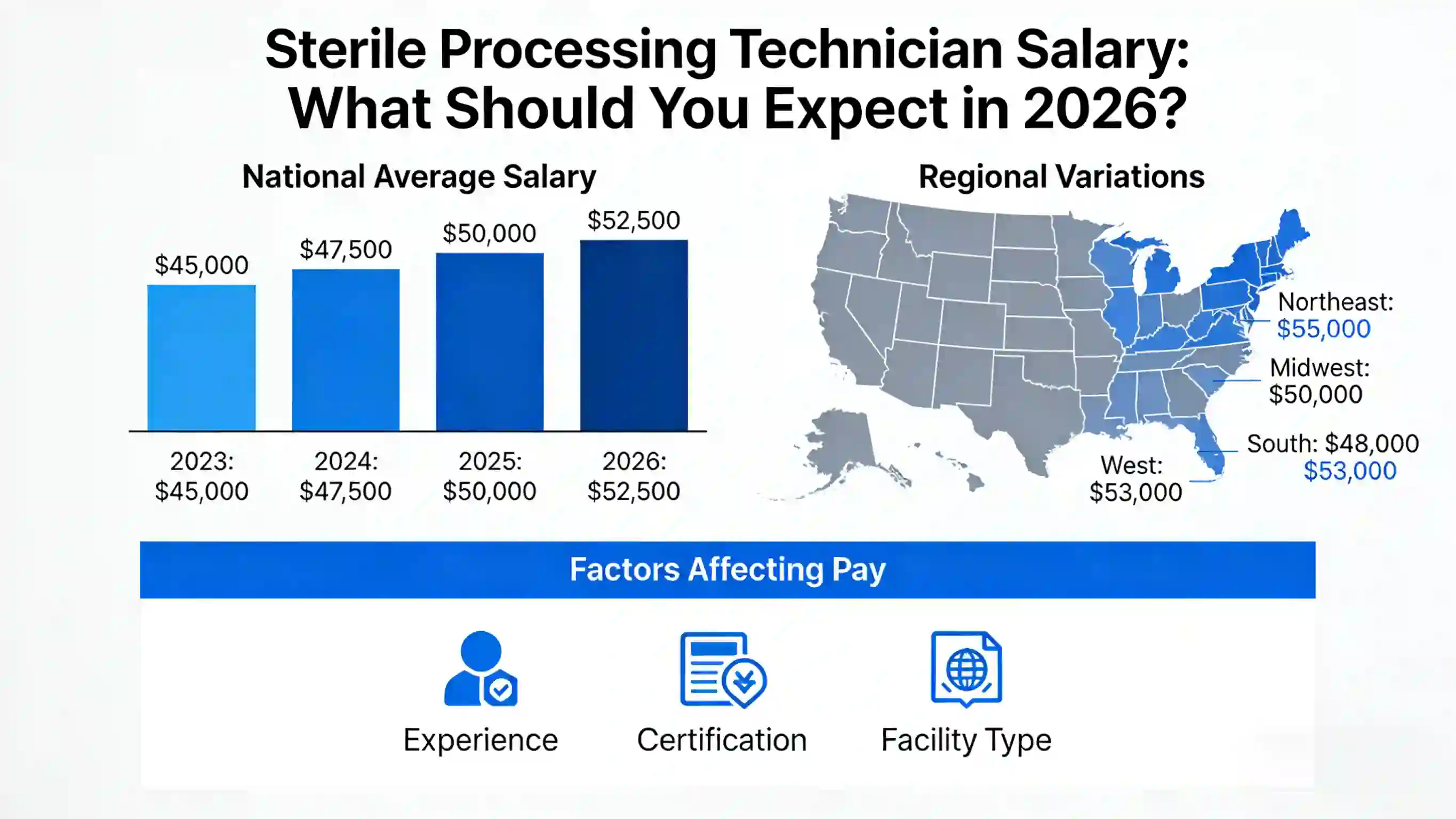
People usually search sterile processing technician salary because they want one clear answer: is this career worth it financially? The honest answer is yes, but only if you look beyond one average number. Sterile processing technician salary can change a lot based on where you work, how much experience you have, whether you hold certification, and whether you take evening, night, or leadership responsibilities. This guide explains the pay data in plain English so readers can understand what a realistic income looks like before applying, relocating, or negotiating.
What is the average salary in the U.S.?
The national benchmark for sterile processing technician salary depends on which dataset you use. Salary.com lists the average U.S. annual pay at $39,640, with most workers earning between $35,448 and $44,680. Herzing, citing BLS data for medical equipment preparers, shows a higher national average of $48,990 per year or $23.56 per hour. The gap does not necessarily mean one source is wrong. In practice, sterile processing technician salary estimates differ because some sites model employer reported compensation, while others group the role under a broader federal occupational category.
A practical way to read sterile processing technician salary data is to treat it as a range, not a fixed promise. If you are entry level in a lower paying region, your sterile processing technician salary may land closer to the low to mid $30,000s. If you work in a stronger market, hold certification, or join a better paying facility, your compensation can move into the high $40,000s or beyond. That is why job seekers should compare multiple sources before deciding what good pay really means for them.

Why does it vary so much by state?
One of the biggest reasons sterile processing technician salary varies is geography. PTT’s state by state guide lists California at $59,490, the District of Columbia at $58,760, Alaska at $52,870, and Hawaii at $52,130 on average. The same guide shows many mid range states clustered around the low $40,000s, while some lower paying states fall into the mid to high $30,000s. That means sterile processing technician salary is not just about the job title. It is also about the labor market attached to your ZIP code.
High paying markets usually combine stronger hospital demand, tighter labor supply, and higher local wage standards. At the same time, a higher sterile processing technician salary does not always mean higher real purchasing power, because rent, transport, and taxes may also be higher. A smarter salary comparison looks at both pay and cost of living. When readers evaluate sterile processing technician salary, they should compare nearby metro areas, not just states, because the difference between two cities in the same state can still be meaningful.
How do experience and certification affect your salary?
Experience changes sterile processing technician salary faster than many new applicants expect. PTT estimates that entry level technicians with 0 to 2 years often earn about $32,000 to $40,000, technicians with 3 to 5 years earn about $42,000 to $52,000, and experienced workers with 6 to 10 years can reach about $52,000 to $62,000. This is why two people with the same job title can report very different sterile processing technician salary numbers online.
Certification and specialization can also raise sterile processing technician salary because employers often pay more for workers who require less supervision and can handle higher risk workflows. Salary.com notes that compensation varies by education, certifications, additional skills, and experience. In real hiring markets, that means a certified candidate or a technician trusted with more complex instrument workflows may see better offers than a brand new applicant with no credential history. In other words, sterile processing technician salary usually improves when your value becomes easier for employers to verify.
What else can increase salary?
Not every increase in sterile processing technician salary comes from changing employers. PTT notes that evening shifts may add $2 to $4 per hour, and overnight shifts may add $4 to $6 per hour. The same guide says specialized work, such as operating room turnover support or scope processing, can command premium pay, while lead, supervisor, and manager roles can push earnings far beyond frontline averages. That means sterile processing technician salary can improve through schedule strategy and role expansion, not only through relocation.
For many readers, the best next step is to ask which lever is easiest to pull. If relocation is unrealistic, a better sterile processing technician salary may come from certification, shift differentials, cross training, or moving into a lead track. If relocation is possible, a stronger market may create the fastest jump. The important point is that sterile processing technician salary is often more flexible than the headline average suggests.
How to evaluate sterile processing technician salary?
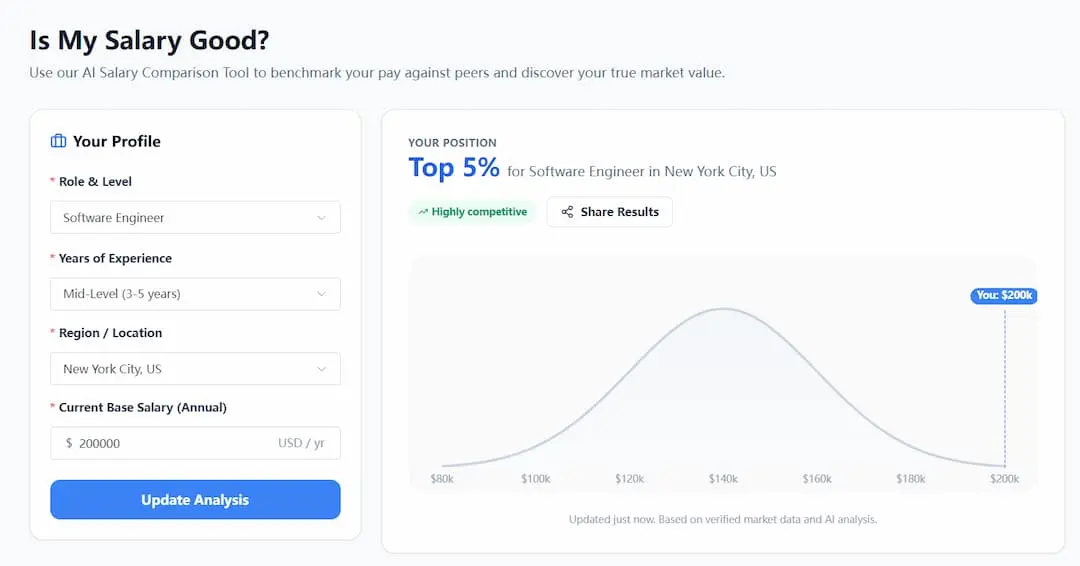
When evaluating sterile processing technician salary, a national average is only a starting point. A more useful method is to compare your pay based on your role, experience, location, and current salary, which is exactly what our Salary Calculator AI is built to do.
As shown in the image, the tool uses four practical inputs: Role and Level, Years of Experience, Region or Location, and Current Base Salary (Annual). This makes sterile processing technician salary analysis more relevant because pay expectations can vary widely across markets and career stages.
After the information is entered, the tool shows a clear benchmark result, including a percentile ranking such as Top 67%, a competitiveness label like Moderately competitive, and a visual salary distribution curve. This helps users understand sterile processing technician salary in a more practical way because it shows whether their current pay is below market, near market, or ahead of similar professionals.
Why Salary Calculator AI matters?
Before applying for a new role, asking for a raise, or considering relocation, users can use the tool to test different scenarios through Update Analysis and share benchmark results through Share Results. That makes sterile processing technician salary easier to discuss with recruiters, managers, or family members using a clearer and more objective market reference.
What is the future outlook for sterile processing technicians?
A realistic outlook for sterile processing technician salary is this: the field usually offers a decent entry point into healthcare, but the best earnings come to people who treat it as a progression path rather than a static job. BLS data for medical equipment preparers shows national mean pay near the upper $40,000 range, while commercial salary platforms place many technician level jobs closer to the upper $30,000s or low $40,000s. Taken together, the message is clear: sterile processing technician salary can be solid, but your outcome depends heavily on where you work and how deliberately you build your value.
The smartest move is not to ask whether sterile processing technician salary is good in the abstract. The smarter move is to ask whether your own sterile processing technician salary is good for your level, region, and responsibilities right now. Once the question becomes specific, better career decisions usually follow.
FAQs
Is sterile processing technician salary good for an entry level healthcare job?
Yes, sterile processing technician salary is often considered reasonable for an entry level healthcare role, especially because the barrier to entry is lower than many licensed clinical careers. The exact value depends on state, shift, certification, and facility type.
Can certification improve sterile processing technician salary?
In many cases, yes. Sterile processing technician salary often rises when employers see certification, stronger skills, and lower training risk. Salary.com explicitly notes that certifications and additional skills can affect pay.
Which states offer the highest sterile processing technician salary?
Recent state level guides place California, the District of Columbia, Alaska, and Hawaii among the stronger markets for sterile processing technician salary, though local cost of living still matters.
How can I check whether my sterile processing technician salary is fair?
The best method is to compare your sterile processing technician salary against your exact role, experience level, region, and current pay using a salary benchmark tool rather than relying on one generic average.
References
Herzing University salary guide for sterile processing
Salary.com U.S. salary benchmark page
PTT state by state salary guide
U.S. Bureau of Labor Statistics wage data for Medical Equipment Preparers