
- What does percentage salary increase mean?
- What is considered a good percentage salary increase?
- Why does the same raise feel different to different people?
- What factors usually influence percentage salary increase?
- Salary growth trends: 2024 vs 2025 vs 2026
- How can you calculate your raise more accurately?
- When should you ask for a higher raise?
- Can switching jobs lead to a larger percentage salary increase?
- FAQs
Percentage Salary Increase: What Counts as a Good Raise in 2026?
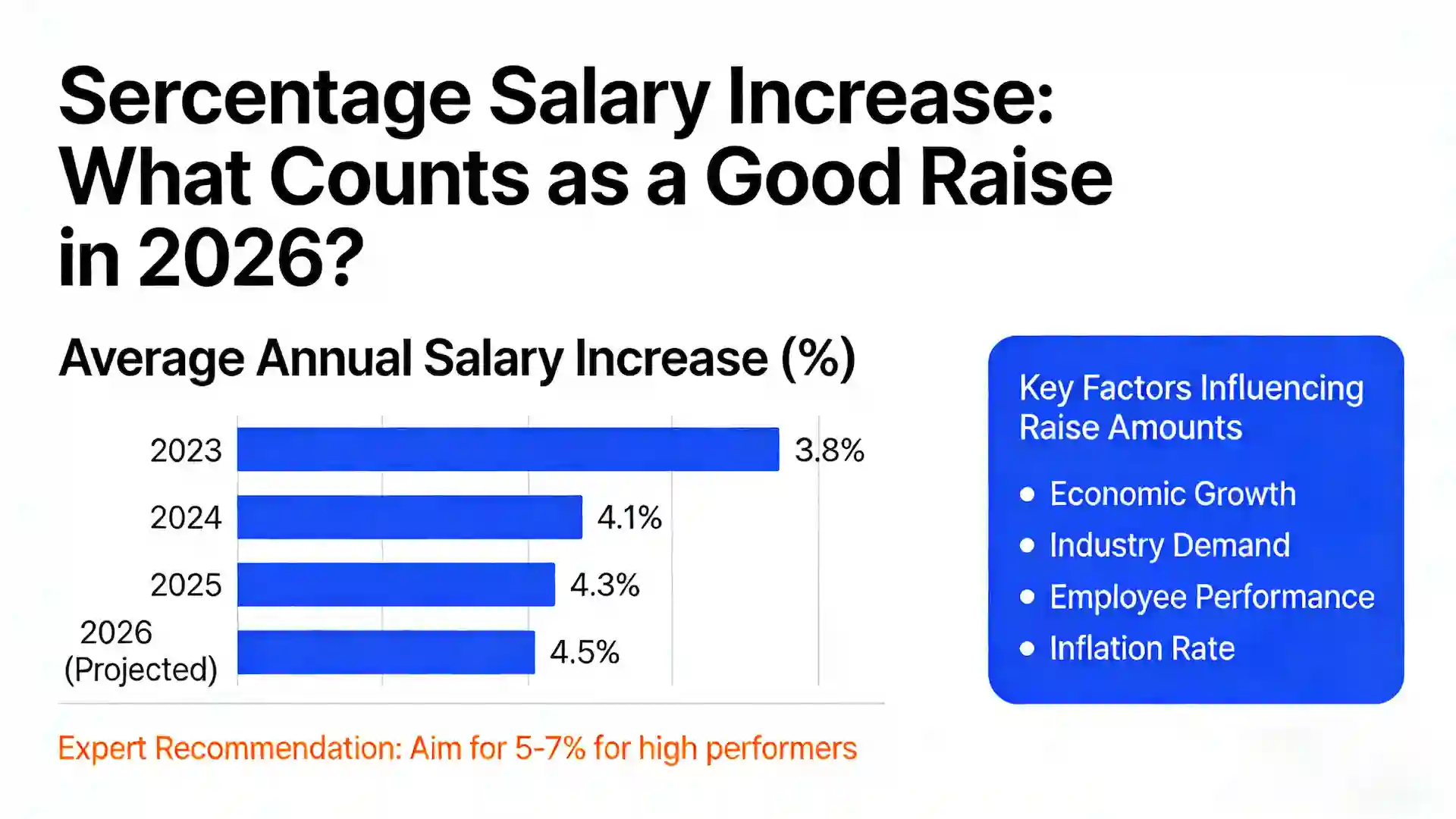
When people talk about getting a raise, they usually focus on the final number. But the more useful question is not just how much more money you will make. It is how that increase compares with inflation, market pay, job performance, and long-term career value. A raise that feels meaningful in one company or one city may be average in another.
Percentage salary increase is one of the clearest ways to evaluate a raise because it shows relative growth rather than just a dollar amount. For example, a $3,000 raise means very different things for someone earning $40,000 and someone earning $120,000. Looking at the percentage helps employees and employers judge fairness more accurately.
What does percentage salary increase mean?
Percentage salary increase refers to the percentage by which your current pay rises over a certain period, usually after an annual review, promotion, role expansion, or job change. It gives a standardized way to compare raises across different salaries, departments, and industries.
The basic formula is simple: subtract your old salary from your new salary, divide the difference by the old salary, and then multiply by 100. If your salary moves from $50,000 to $55,000, your increase is 10%. This makes it easier to discuss compensation in a way that is consistent and measurable.
What is considered a good percentage salary increase?
A good raise depends on context, but broad benchmarks still matter. On average, annual raises are often around 3%, while stronger increases may land closer to 4% to 5%, and a 10% raise is generally seen as above average unless there is clear performance or market justification. According to a report by WTW (Willis Towers Watson), employers are expected to hold their salary budgets relatively stable in 2024, with average raises staying around 4%, reflecting a more conservative approach as employee bases stabilize.
In practical terms, a 2% to 3% raise may be considered modest, a 4% to 6% raise reflects a competitive compensation increase, and anything above 8%–10% is often tied to promotions, retention moves, or external offers — depending on company performance and job market demand.
Why does the same raise feel different to different people?
The same percentage can create very different outcomes depending on cost of living, family obligations, debt, and existing salary level. A 5% raise may feel meaningful for someone whose compensation is already competitive, but disappointing for someone who has been underpaid for years.
Inflation also changes how a raise feels. If prices are rising quickly, a small raise may protect very little real purchasing power. A raise that doesn’t outpace inflation might feel like less of a win. For example, in the Los Angeles area, the Employment Cost Index showed a 4.1% increase in compensation costs in the past year, signaling that while employers are offering higher raises, the rise still lags behind overall inflation.
This is why understanding your salary's position relative to others in the same region and role is critical.
What factors usually influence percentage salary increase?
Salary increases are rarely based on one reason alone. Employers usually look at company performance, departmental budgets, market salary ranges, local labor demand, employee tenure, and individual contribution. In many organizations, raises are also shaped by whether the increase is a cost-of-living adjustment, a merit increase, or part of a promotion cycle.
This is why employees should avoid comparing raises without context. A 4% raise at a company with narrow salary bands may be generous, while the same figure at a fast-growing company in a competitive market may be weak. The number matters, but the compensation environment matters just as much.
Salary growth trends: 2024 vs 2025 vs 2026
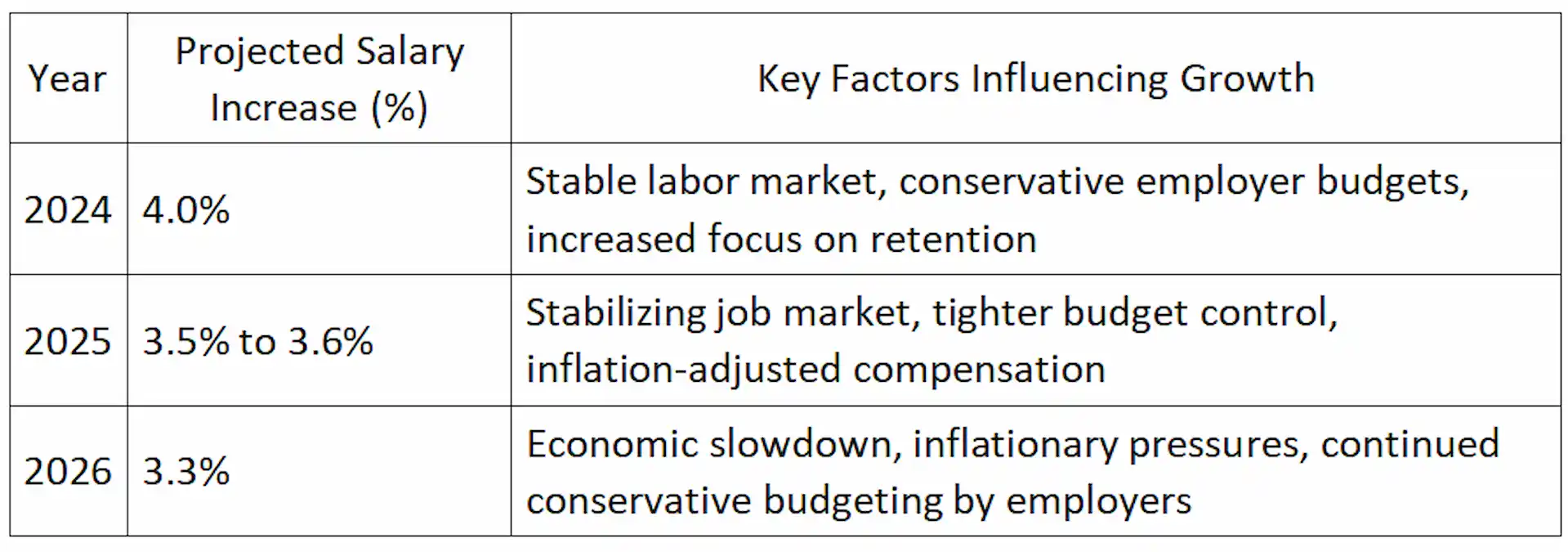
To provide a clearer understanding of how Percentage Salary Increase has evolved and what trends to expect, here’s a comparative chart of projected salary growth rates over the next few years.
Analysis of the trends
As we move into 2024, employers are expected to offer an average salary increase of around 4.0%, reflecting a slightly more conservative approach following several years of higher-than-usual raises. This increase is largely attributed to stabilization in the labor market, where employee retention and competitive compensation are key priorities, according to WTW’s 2024 Salary Budget Planning Survey.
For 2025, while the U.S. job market is expected to remain stable, the rate of salary increases is likely to plateau, with growth forecasts of around 3.5% to 3.6%. This slowing growth is driven by tighter employer budgets and inflationary pressures that impact employer compensation plans. By 2026, compensation growth could dip slightly to around 3.3%, largely due to the continued focus on fiscal restraint and the potential for an economic slowdown.
How can you calculate your raise more accurately?
Many employees know they got a raise, but they do not know whether it is actually competitive. That is where a structured calculator becomes useful. Instead of relying on instinct, you can compare your old salary, new salary, expected inflation impact, and target compensation range in a more objective way.
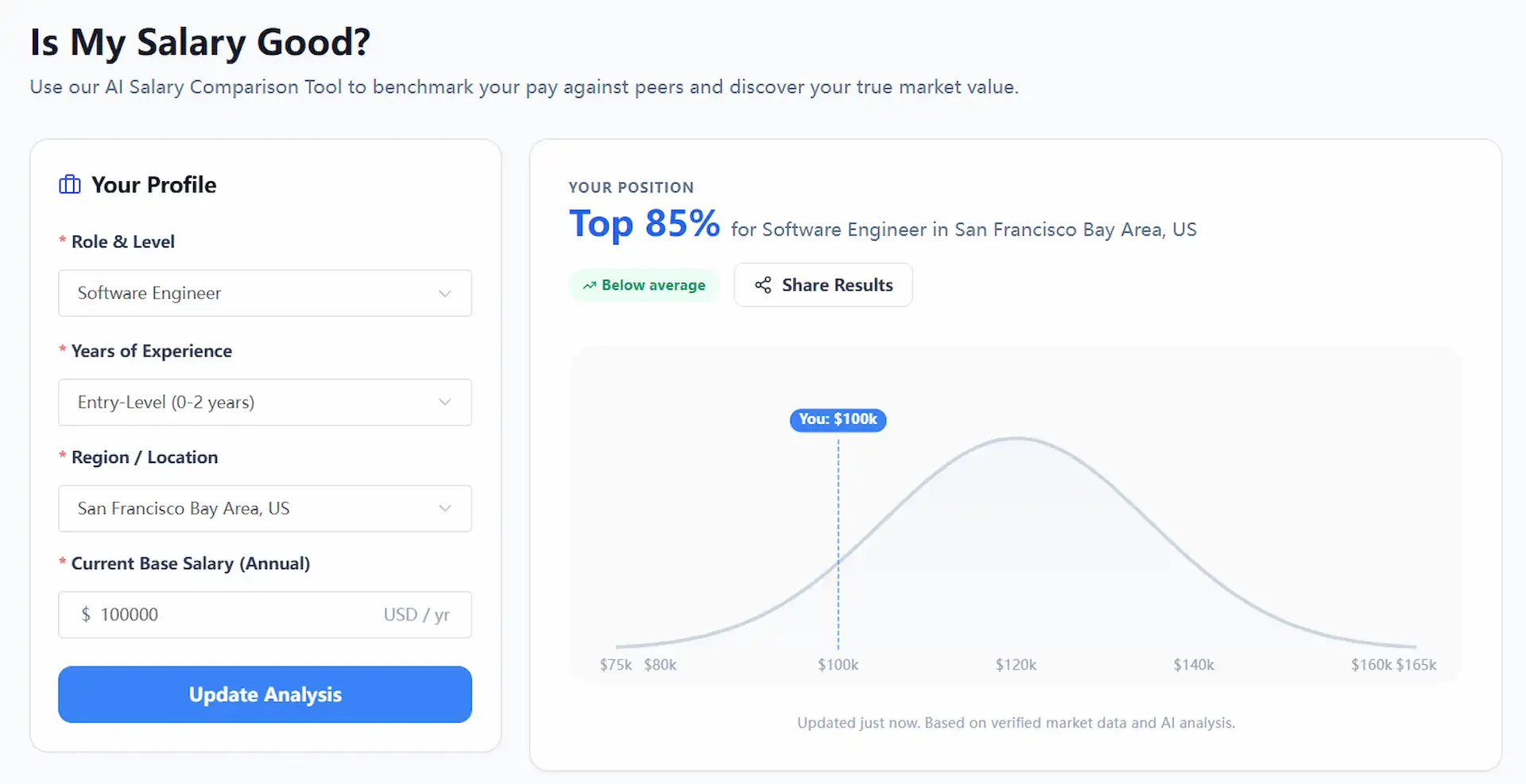
Salary Calculator AI can play an important role here. It helps users quickly calculate their percentage salary increase, compare their salary against market averages, and see whether their raise aligns with industry standards. By simply entering your role, years of experience, location, and current salary. Salary Calculator AI will benchmark your compensation against peers in your field.
This tool provides a clear visualization of where you stand relative to others. For instance, if you’re in the Top 81% of software engineers in the San Francisco Bay Area, the AI tool will show you exactly how your salary compares to the market, giving you actionable insights on whether your raise is in line with market expectations.
This feature simplifies salary discussions and empowers employees with the data they need to negotiate better pay, whether you're preparing for an annual review or considering a job offer comparison.
Make the case for a better salary increase
A persuasive raise conversation depends on evidence. Researching market trends, highlighting your achievements, and presenting future contributions are essential. By supporting your request with clear data and measurable outcomes, you make your case stronger.
Knowing what similar roles are paid and understanding how your salary compares to industry benchmarks will help you negotiate more effectively. Salary Calculator AI can assist in this preparation by offering a comprehensive comparison based on the most up-to-date salary data available.
Is a bigger raise always better than better benefits?
Not necessarily. A higher base salary is important, but total compensation can sometimes matter more. If a traditional raise is limited, other forms of compensation such as bonuses, additional paid time off, healthcare support, retirement contributions, and childcare subsidies may still increase total value.
For some employees, a slightly smaller raise combined with a strong performance bonus or better long-term benefits may be the better deal. The best compensation package is not always the one with the biggest headline raise. It is the one that improves your total financial position and supports your future earning power.
When should you ask for a higher raise?
Timing matters almost as much as performance. Annual reviews remain the most common moment to discuss compensation, but they are not the only opportunity. If your responsibilities have expanded, your results are measurable, or the market rate for your role has changed significantly, you may have a credible reason to ask sooner.
The strongest time to ask is usually when your value is visible. If you can point to retention impact, revenue growth, efficiency improvements, project ownership, or scarce technical skills, your request becomes easier to justify. A raise conversation should feel like a business case, not a personal complaint.
Can switching jobs lead to a larger percentage salary increase?
Changing jobs is still one of the most common ways to secure a larger pay increase, with 10% to 20% increases often being more achievable through job switching than through staying in the same organization.
This does not mean everyone should leave. Staying can still make sense if your employer offers strong advancement, better benefits, a healthier culture, or clear long-term upside. But if your pay remains below market and your raises stay limited year after year, an external move may reset your compensation more effectively than internal negotiation.
FAQs
What is the average raise percentage for 2026?
Based on current trends, the average salary raise percentage for 2026 is projected to be around 3.3% to 3.6%. This reflects a more conservative approach to salary increases as inflation stabilizes and labor market conditions continue to normalize.
What is a typical raise percentage for a promotion?
A typical raise percentage for a promotion generally ranges between 8% to 10%, depending on the company, industry, and the level of the promotion. Higher raises can also be seen when employees take on significantly more responsibilities or when the job market is particularly competitive.
What is a good annual raise percentage?
A good annual raise typically falls between 3% to 5%, which accounts for inflation and cost-of-living adjustments. Higher increases may indicate exceptional performance, industry growth, or promotions, while lower percentages might reflect cost control measures or more challenging economic conditions.
Salary increase percentage calculator: where can I find one?
You can easily calculate your salary increase percentage using tools like the Salary Calculator AI, which helps compare your salary against the market and provides insights on whether your raise is in line with industry standards. Tools like these are available online and can help you make informed decisions about your compensation.
What is the cost of living raise percentage?
The cost of living raise percentage varies by location, but on average, it is aligned with inflation. For example, if inflation is 3.4%, a raise that matches this percentage helps employees maintain their purchasing power. However, it is important to note that cost-of-living adjustments may not always fully keep up with inflation, depending on employer policies and regional economic conditions.
What is the pay rise percentage for 2026?
The pay rise percentage for 2026 is expected to range between 3.3% and 3.6%, with companies continuing to offer stable, but somewhat conservative, raises in response to ongoing economic factors. This is slightly lower than 2024 and 2025 predictions due to economic slowing and inflationary impacts.
References
- WTW. "++2024 Employee Pay Trends++."
- PayScale. "++Worker Expectations Clash With Economic Realities, Payscale's 2024 Compensation Best Practices Report Reveals++."
- WTW. "++US Employers More Conservative with Salary Budgets as Employee Base Stabilizes++."
- HRPA. "++Early 2025 Salary Budget Projections Tempered by Economic Concerns++."
- Mercer. "++Will 2025 Increase Budgets Be Lower Than Last Year?++"