
- What are part time remote jobs?
- Common types of part time remote jobs
- Best websites to find part-time remote jobs
- Why hourly rate alone doesn’t tell the full story?
- W2 vs 1099 for part time remote jobs
- The self-employment trap many remote workers miss
- Compare take-home pay with Salary Calculator AI
- Example: A $40/hour remote job comparison
- Final thoughts
- FAQs
Part Time Remote Jobs: W2 vs 1099 Pay Comparison Guide
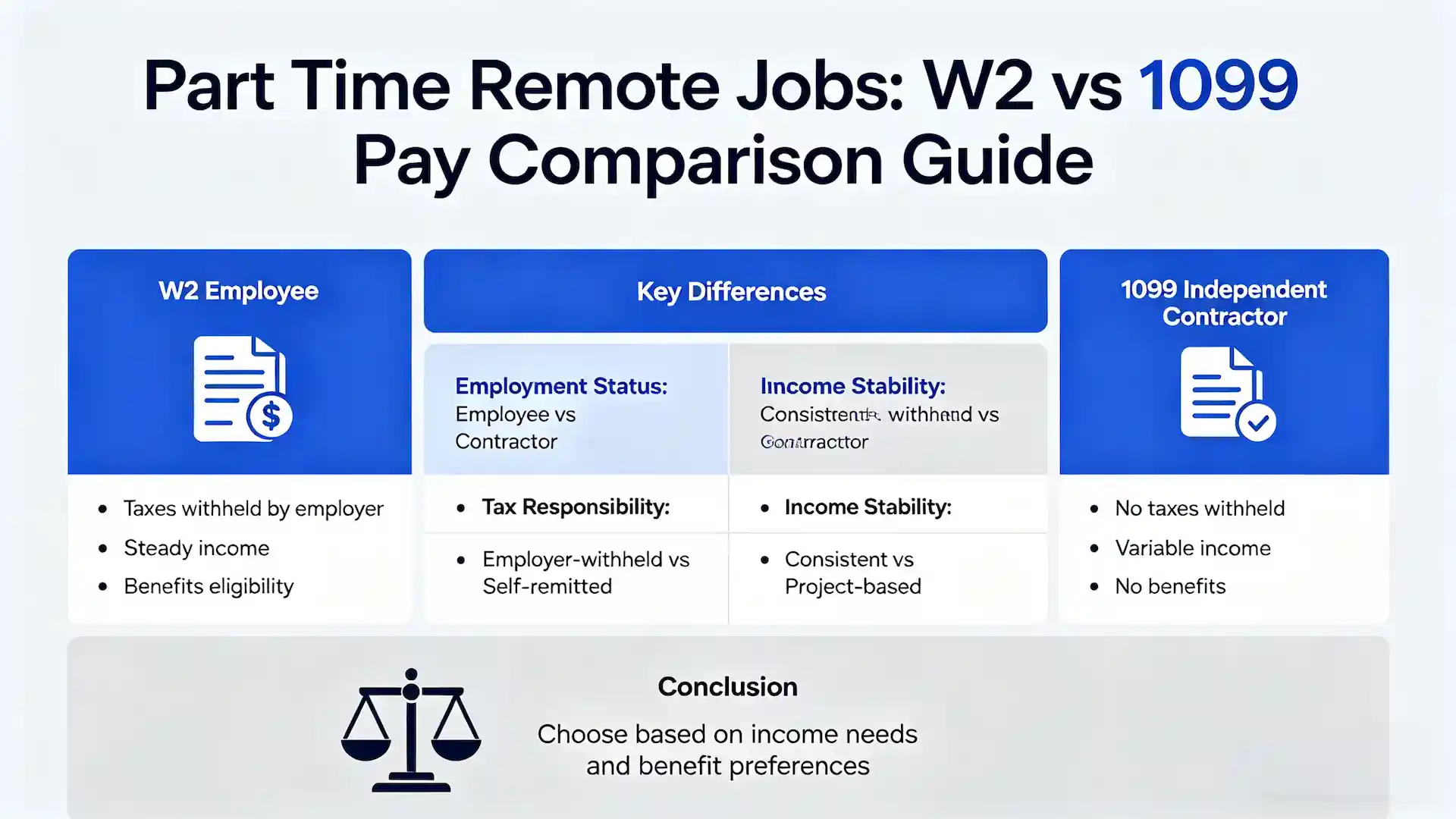
Part time remote jobs are appealing for a simple reason: they offer flexibility. For students, parents, side hustlers, and professionals testing a new path, it can create extra income without requiring a traditional full-time schedule. Remote job boards such as Remote.co and FlexJobs specifically position part-time remote work as a practical option for people balancing other commitments, and they list openings across administrative, customer service, bookkeeping, copywriting, and data-entry categories.
But there is a question many job seekers miss when comparing part time remote jobs: which offer actually leaves you with more money after taxes? A role with a higher hourly rate may look better on paper, yet the final result can change a lot depending on whether the job is structured as a W2 employee role or a 1099 contractor role. That is the real comparison most people should make before saying yes to an offer.
What are part time remote jobs?
Part time remote jobs are jobs you can do remotely without committing to a full-time weekly schedule. Some are traditional employee positions with set hours. Others are freelance, contract, or project-based roles with more flexible arrangements. In practice, that means two remote roles with very similar tasks may be taxed and paid in very different ways.
Common types include remote customer support, virtual assistant work, online tutoring, bookkeeping, copywriting, data entry, and administrative support. Search results and job boards consistently show these categories because they are among the most common ways people enter part-time remote work.
Common types of part time remote jobs
Remote customer service jobs are popular because businesses need chat, email, and phone support across time zones. These jobs are often easier to understand operationally and may be offered as either W2 roles or contractor roles depending on the employer.
Virtual assistant and administrative support roles are another common path. These jobs may involve scheduling, inbox management, research, CRM updates, and appointment coordination. They are especially common in small businesses and founder-led teams.
Online tutoring, writing, bookkeeping, and data-entry roles also show up frequently. These jobs can work well for part-time schedules, but the financial structure matters. One employer may hire you as an employee with payroll withholding, while another may engage you as an independent contractor responsible for self-employment tax and estimated payments.
Best websites to find part-time remote jobs
If you are looking for part-time remote jobs, it helps to start with a few trusted job websites instead of searching randomly. Some platforms are better for broad job discovery, while others are more focused on flexible remote work, freelance projects, or curated opportunities. Here are a few useful places to start.
- Indeed – Best for broad job volume and quick filtering by keywords, location, posting date, and part-time preferences.
- LinkedIn Jobs – Useful for finding remote part-time positions while also checking company background, hiring activity, and mutual connections.
- Remote.co – A strong option for remote-first opportunities, especially if you want listings that are clearly positioned as remote work rather than general job board results.
- FlexJobs – Known for flexible and remote-friendly roles, including part-time, freelance, and hybrid options across different industries.
- DailyRemote – Helpful for browsing remote openings by category and staying closer to remote-specific hiring trends.
- Upwork – Useful if you are specifically looking for project-based or contractor-style work instead of a traditional employee role.
However, finding job listings is only the first step. Once you have a few part-time remote roles to compare, the real question becomes whether the offer is a W2 role or a 1099 contractor role — and how much you actually keep after taxes.

Why hourly rate alone doesn’t tell the full story?
This is where many job comparisons go wrong. People see two offers and naturally compare hourly pay first. But take-home income depends on more than the posted number. Taxes, worker classification, benefits, and even where you live can all change the real outcome.
A $35 per hour contractor role may look better than a $30 per hour employee role. But if the contractor role requires you to handle your own self-employment taxes and offers no benefits offset, the gap may shrink or even reverse. In other words, gross pay is not the same thing as adjusted net income.
W2 vs 1099 for part time remote jobs
The IRS says worker classification depends on the relationship between the worker and the business, including behavioral control, financial control, and the nature of the relationship. In general, employees are treated differently from independent contractors for tax purposes.
A W2 role usually means the employer handles payroll withholding and pays the employer side of certain payroll taxes. A 1099 role generally means you are self-employed for tax purposes, responsible for your own income-tax payments and self-employment tax obligations. The IRS notes that self-employment tax covers Social Security and Medicare taxes, and the self-employment tax rate is 15.3%.
That difference is exactly why two offers with the same hourly rate may not feel the same in your bank account. The task list may look similar, but the pay structure behind the offer can lead to very different take-home results.
The self-employment trap many remote workers miss
A lot of remote workers focus on the number in the job post. That is understandable. Higher hourly pay feels like a win. But contractor roles can create what many people experience as a self-employment trap: the headline rate looks strong, while the after-tax result feels weaker than expected once tax obligations and missing benefits are factored in.
This matters even more for remote part-time positions because people often use them to supplement income, not to create a full financial system around a business. If your goal is simple extra income, tax simplicity and predictability may be just as valuable as a higher advertised rate. That is why some lower-rate W2 roles can be more attractive than seemingly better 1099 offers. This is an inference based on IRS tax treatment and the way part-time remote job boards frame flexibility and side-income use cases.
Compare take-home pay with Salary Calculator AI
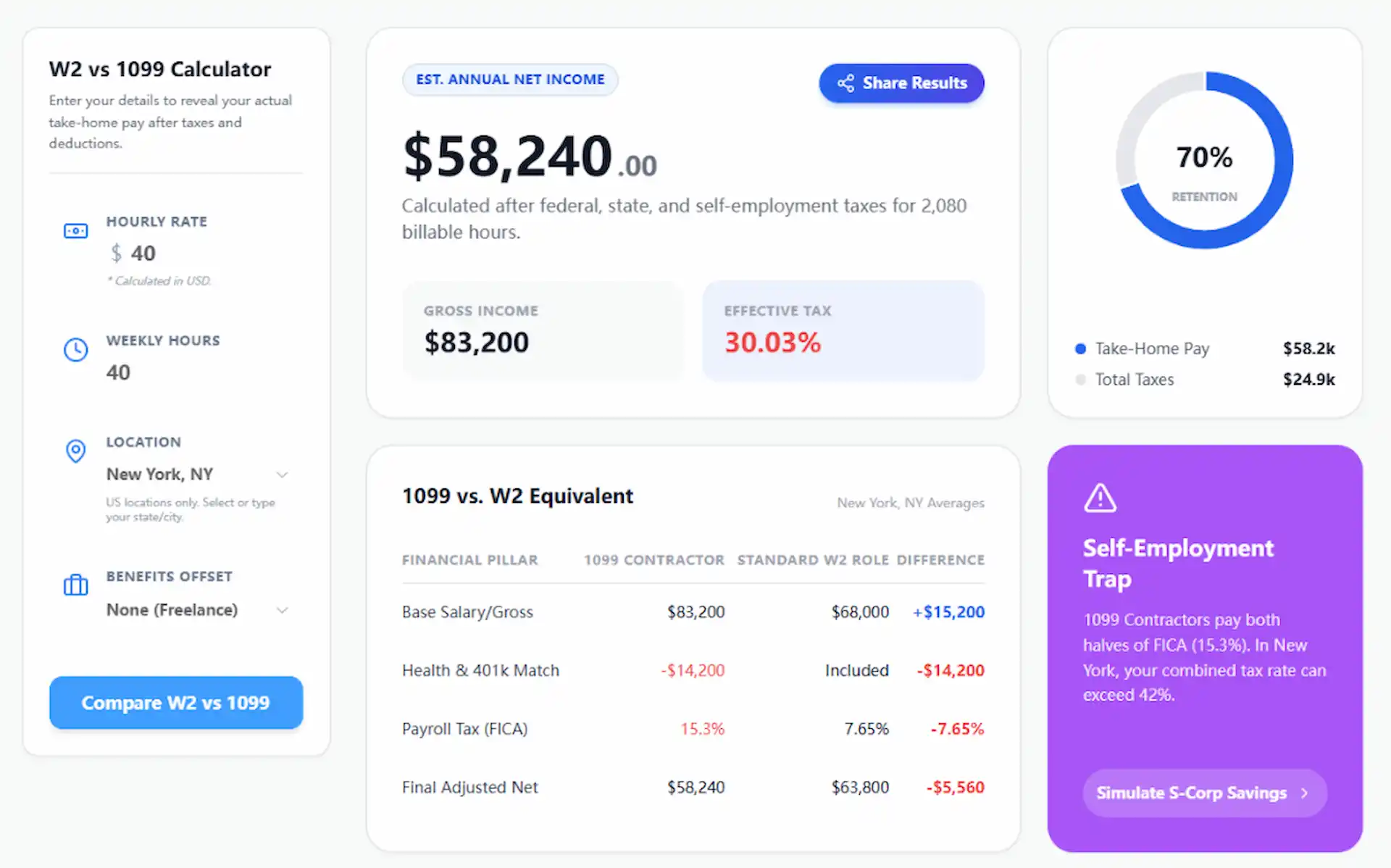
This is exactly where a W2 vs 1099 calculator becomes useful. Instead of guessing, you can compare two offers based on hourly rate, weekly hours, location, benefits offset, effective tax, and estimated annual net income. That turns a vague “Which job pays better?” question into a more useful decision: “Which job leaves me with a better after-tax outcome?”
If you are comparing part-time remote positions on Salary Calculator AI, the tool is most helpful when two offers look close on the surface. A contractor role may seem to win on hourly rate, while a W2 role may prove stronger once payroll taxes and benefits are considered. That is the kind of comparison job seekers should make before accepting a remote offer.
Example: A $40/hour remote job comparison
Imagine you are evaluating a remote role at $40 per hour. On the surface, that sounds straightforward. But once you compare the same rate across different classifications, the outcome may change. In your calculator workflow, factors such as location, weekly hours, effective tax, and benefits offset make the comparison much more realistic than a simple hourly-rate calculation.
That is the real value of the article’s core message: the best part-time remote role is not always the one with the biggest number in the headline. It is the one that delivers the better result after taxes and trade-offs.
Final thoughts
The best part-time remote job is not always the one with the highest hourly rate. It is the one that works for your schedule, matches your goals, and gives you the better after-tax result. Remote job boards are useful for finding opportunities, but they do not always answer the deeper financial question. That is where comparing W2 vs 1099 pay becomes much more useful than simply scrolling through job titles.
Before you accept a remote offer, compare the real numbers. Use Salary Calculator AI to evaluate W2 vs 1099 pay, taxes, and take-home income so you can choose with more confidence.
FAQs
Are there part-time remote jobs posted in the last 3 days?
Yes. Many remote job boards update listings daily, and filters such as “last 24 hours” or “last 3 days” are common. But a fresh post should still be evaluated based on classification, taxes, and take-home pay, not just recency.
What are good part-time remote jobs?
Good roles usually balance flexibility, fit, and financial value. Customer service, virtual assistant work, tutoring, writing, bookkeeping, and data entry are all common categories, but the right choice depends on whether you prefer W2 stability or 1099 flexibility.
Are remote part-time jobs hiring immediately?
Some are, especially in support and admin functions. But “hiring immediately” does not automatically mean “best financially.” Fast-moving roles should still be checked for tax treatment, guaranteed hours, and realistic net income.
Can I find part-time remote jobs that pay in USD?
Yes. Many global companies and clients pay in USD. But currency alone does not determine value; what matters is what remains after taxes and work-structure differences.